

How should African creatives work with AI?
For African artists of every kind, grappling with the impact of AI on creative work is no easy task, writes Chris Roper. But ensuring the ongoing health of the African imaginary means it must be done

For those who live in the creative world, the seductive potential of AI is twofold. There’s the utilitarian value it can bring, cutting down the time it takes to accomplish mundane, bureaucratic activities attached to the creative process. And there’s the thrill of the new, of how AI can be used to create beauty in new forms. Before you decide where and how you will use AI, though, you have to answer the fundamental question: do I actually want to use AI?
As much as it feels like that question has already been answered on your behalf, it is still possible to avoid a wholesale dive into the clutches of predatory big tech. Indeed, there is a burgeoning movement by young people of the world to reject the overblown promise of AI hype, and to demand human authenticity.
This essay won’t go into the utilitarian value of AI. That’s a conversation for you and your AccountantBot, although it is worth noting that using AI is about to get much more expensive now that we’re moving out of the loss-leader phase. Still, AI tools can help creatives in many ways. A few prompts to your AI assistant, carefully personalised to your own needs, and you’ll have your boring admin emails laid out for you, for example. But can you prompt your AI to help you with your artwork? Your music? Your creative writing? And still call it yours? Where we need to fight our identity battles is where our creative output takes place, in that intersection between brain and heart.
This is how Cape Verde’s culture minister put it, during April’s Atlantic Music Expo in his country. Speaking about AI, he told the Guardian, ‘You have to work with it, not to be eaten by it. I think that AI will never cover what’s authentic … AI is the present already, so we have to discuss this and find ways to work with AI for the country, for the culture and for the future.’ I would add to that, for the continent.
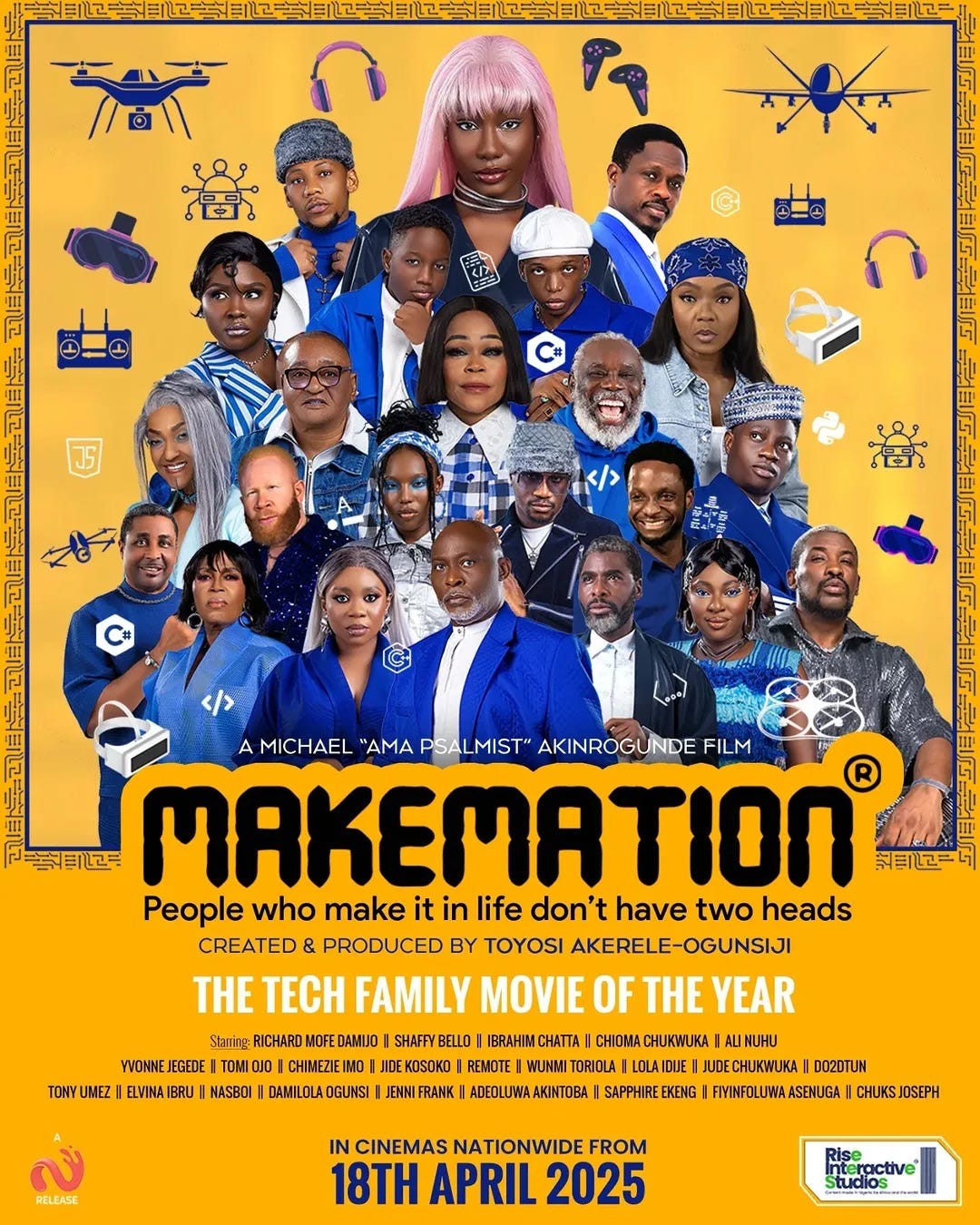
This is something many African creatives are aware of, and some are intimately involved in redressing in their art. Last year’s Nigerian movie Makemation, for instance, aims to ‘[challenge] the dominance of western techno-narratives’ and, according to The Conversation, ‘places AI within local histories of inequality, aspiration and improvisation’. And while all this sounds like a laudable accomplishment, the fact that it was made by ‘AI-developer-turned-filmmaker Toyosi Akerele-Ogunsiji’ also makes one pause to consider… because this sounds like it might be an instance of AI coming for your job.
The thing is, while AI might take your job, it’s unlikely to be able to take your art. Those whose main concern is the business of art, like film studios, will (and already have) leapt at the money-saving opportunities of replacing their humans with AI. But by many measures, the art produced by AI is bad art. This leaves human artists grappling with the key problem of how to make sure the human consumers of your art understand, and more importantly, feel, that there is a qualitative difference between LLM slop and real art. Writer Sam Kriss puts it bluntly on his Substack: ‘AI will never fully replace human musicians, even if it can reproduce any possible sound, because it can’t get addicted to heroin and kill itself.’
This very platform, The African Imaginary, is based on the notion that there is a certain authenticity that lived experience brings to the creative act. I say creative act, rather than creative product, because this is where AI is inferior to the human. It cannot act, only react. For all the hype about generative AI, it is an artificial imaginary that relies on your stolen work to produce an artefact.
This is by no means an uncontested position. If you are willing to concede that Marcel Duchamp’s 1917 artwork, ‘Fountain’ (a porcelain urinal signed R. Mutt), is art by virtue of the fact that Duchamp placed it in a gallery, then you might need to concede that AI-generated imagery can be art if a human artist defines and deploys it with intention.
When it comes to using AI to make music, there are surprising consequences when it comes to copyright issues. In the USA, AI-generated music can’t have copyright assigned to it because it doesn’t have a human creator. So people using AI have been dumped by record companies because they can’t protect the master recordings, making the investment extremely difficult to protect legally. If you’re an African musician, you might be doubly depressed at this, given that many of Africa’s music markets are especially vulnerable to the threat of plagiarism, due to our comparatively weak legal frameworks around intellectual property protection.
In a 2025 report, Deezer revealed that roughly 50,000 fully AI-generated tracks are uploaded to the streaming platform every day, accounting for 34% of all daily deliveries. They also found that 97% of people couldn’t tell the difference between fully AI-generated music and human-made music in a blind test with two AI songs and one real song. If you are someone who makes a living, and lives a life, by creating art, you might be very, very scared at this point. Or you could see this tsunami of AI slop as an opportunity. The Deezer survey also showed that people care about music, and they want to know if they’re listening to AI or human made tracks. This is where authenticity becomes a brand USP, and a human differentiator.
We also know that Anthropic was ordered to pay a $1.5bn settlement after a coalition of authors sued the company for using nearly 200,000 copyrighted books to train its large language models without compensation or consent. But what you might have missed is that only authors whose books were registered in the US were compensated. If you were an African artist whose book was pirated, as in the case of Kenya’s Billy Kahora and Nigeria’s Damilare Kuku, and your copyright wasn’t registered in the USA, you didn’t qualify for the (paltry) $3,000 per work.
This is extractive colonialism at its most egregious, and I don’t have to remind you of how that works. But this is probably an appropriate place to quote Cape Verde’s secretary of state for the digital economy, Pedro Fernandes Lopes, talking to the Guardian about his country’s attempts to reverse the postcolonial brain drain by growing the digital economy.
The routes enslaved people were taken along from Africa are the same routes that the submarine cables pass along in the Atlantic, which is crazy. History repeats itself – but each generation has an opportunity to tell their own history.
This is a crude analogy, but here it is: if creatives don’t understand the colonising power of AI, and don’t always have that in the front of their minds, we’ll end up in a place where we just become a conduit of raw material to the AI empire of the west (and of China, but that’s a discussion for another day) along those cables that mimic the Atlantic Crossing of slavery.
Appropriately, some AI art is already being used to make this point. Nigerian artist Minne Atairu’s work ‘Deshrined Ancestors’ (2024) uses AI to create speculative representations of looted Benin bronzes, and to comment on the ongoing repatriation debate. The work plays with notions of who creates archives, and of who trains LLMs.
And then there’s the obverse, from Obvious, a French AI art collective. In 2020, they exhibited ‘Facets of AGI’. For this work, they scraped thousands of images of sacred African ritual masks and spiritual objects to train machine-learning models so they could produce AI-generated works that were exhibited and sold internationally, without any consultation with the African communities whose traditions produced them, let alone any compensation. The same objects once locked in Western museums are now doubly exploited, entering circulation as data points in private AI datasets.
This digital extractivism – the way the colonial economy also shapes the digital realm – is what we need to be wary of. Sadly, the more you become part of the AI Empire, the more you risk having your soul turned into raw material for the robots. You can choose if you want to use AI or not, but you don’t get a choice about the fact that AI is going to use you. You don’t really have a feasible way to opt out of a technology that is reshaping the world.
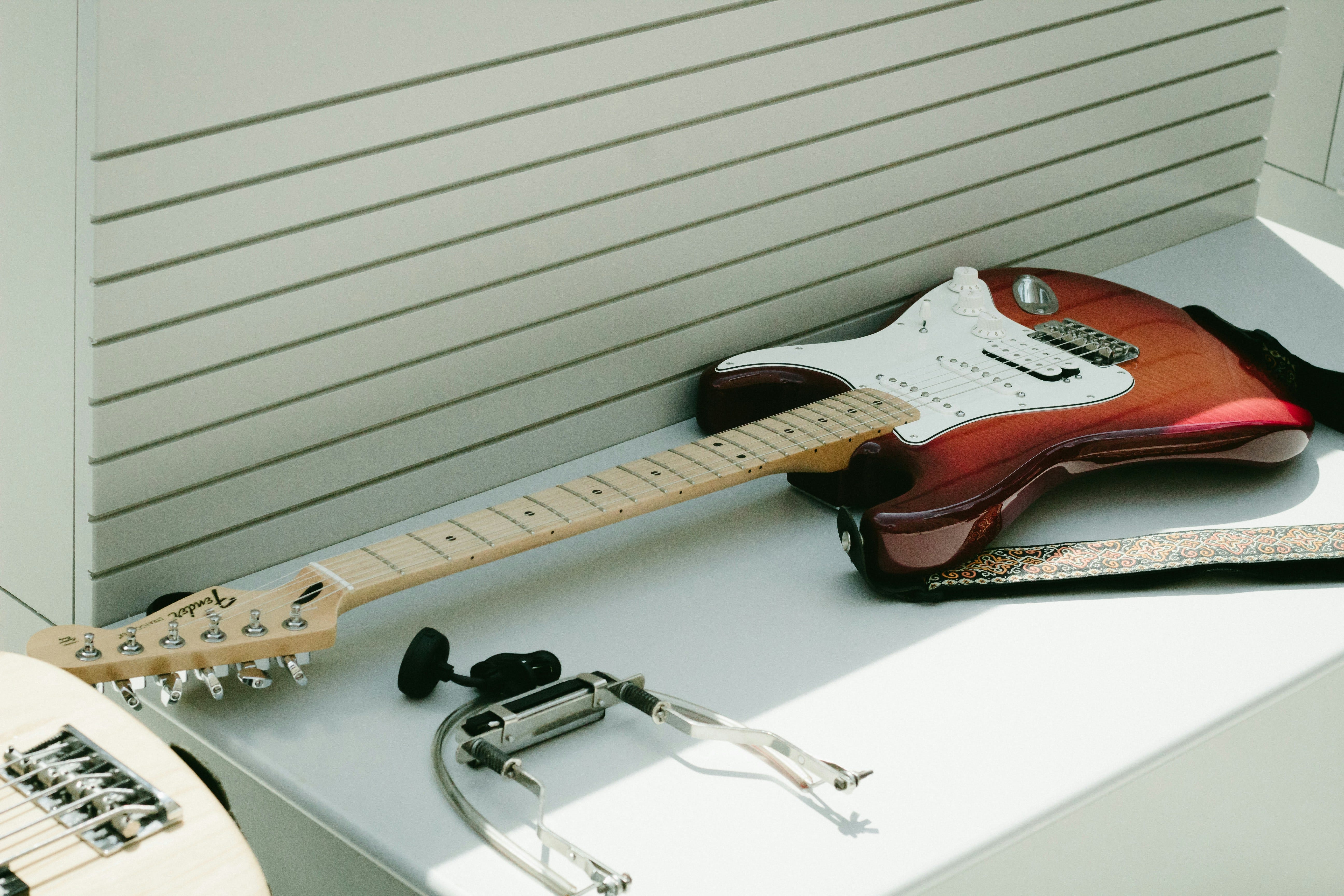
Electric guitars also arrived in Africa as a colonising technology, built elsewhere, with foreign aesthetics and power structures encoded within them. African musicians turned guitars into African instruments by bending them to local styles, and to local cultures. How we use AI tools will likely repeat that pattern. They are trained largely on non‑African catalogues and owned by the oligarch predator class, so by default they risk extracting from African archives rather than serving them.
But we can take a lesson from the way the electric guitar was localised. It’s up to African creatives and institutions – and there are already many doing this, like Masakhane and GhanaNLP – to localise these tools, shape their training data, and claim ownership of both the infrastructures and the art they produce, or else the technology will once again speak about Africa rather than from it.
Talking about Ali Farka Touré, one critic wrote, ‘He may be taking the physical music-making tools of the West, but his palette is all his own.’ That’s the challenge for today’s African creatives using AI, or being used by AI: how to preserve authenticity, how to cultivate an audience that values that, and how to evade assimilation into the LLMs.
Chris Roper works in the messy intersections of technology, media and meaning. More prosaically, he is a senior strategist at Code for Africa, working on projects ranging from state influence operations in the Sahel to AI implementation in African newsrooms. He is a former editor in chief of Mail & Guardian and 24.com, and has a weekly column for the Financial Mail.